
No-Extinction Practical Guide
What can I do?
Ten concrete areas to turn awareness into choices, participation and collective action.
The great global problems can seem too vast for a single person to make a difference. But that does not mean what we do is irrelevant.
Our choices influence consumption, business, culture and politics. And when millions of individual choices become participation and collective action, they can help change the rules as well.
You do not have to do everything. Choosing one step, then another, is already a way to begin.
The two documents
TWO PRACTICAL GUIDES, TWO HORIZONS
One focuses on what we can do today.
The other looks at the major collective transformations needed to build the future.
They are not definitive programs. They are tools to use, discuss and improve.
PRACTICAL GUIDE FOR ACTION TODAY
What we can do today
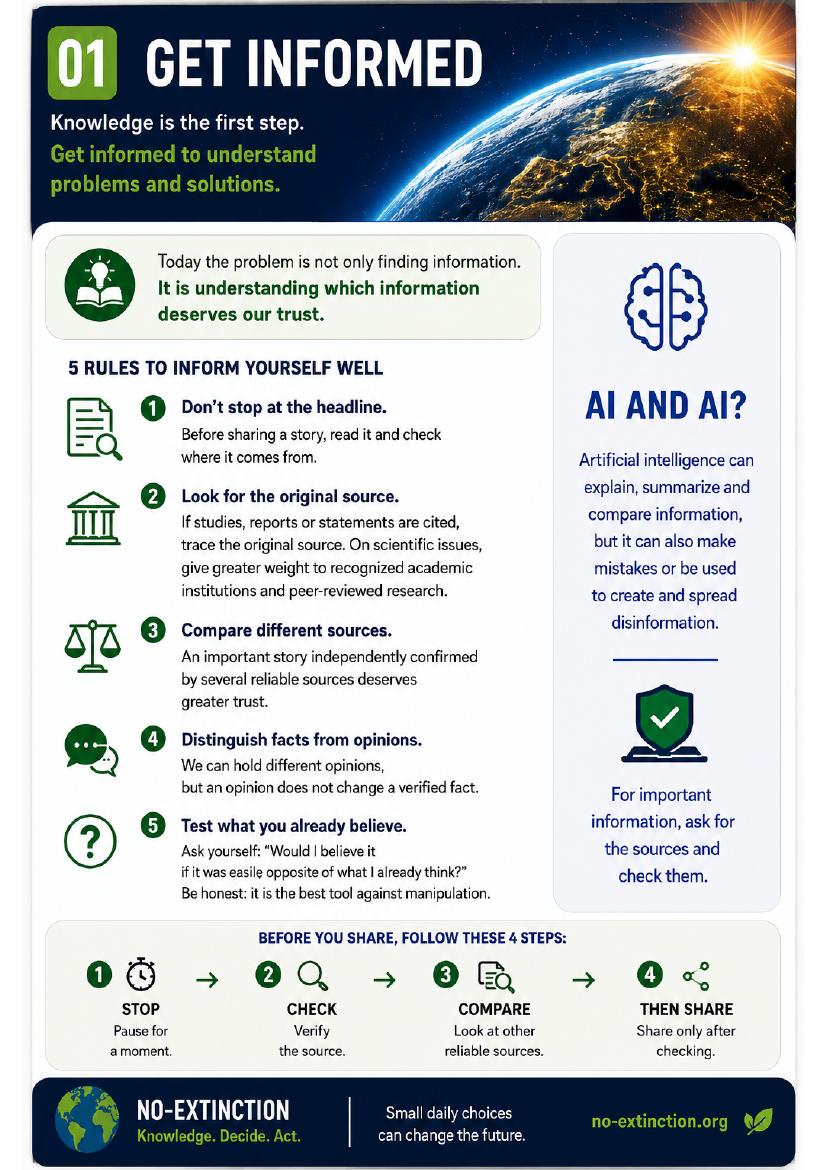 Preview of the first page
Practical ideas for turning knowledge and awareness into everyday choices, participation and collective action.
12 pages · Read, keep, print and share
DOWNLOAD THE PRACTICAL GUIDE FOR ACTION TODAYPRACTICAL GUIDE FOR THE FUTURE
Five directions for building the future together
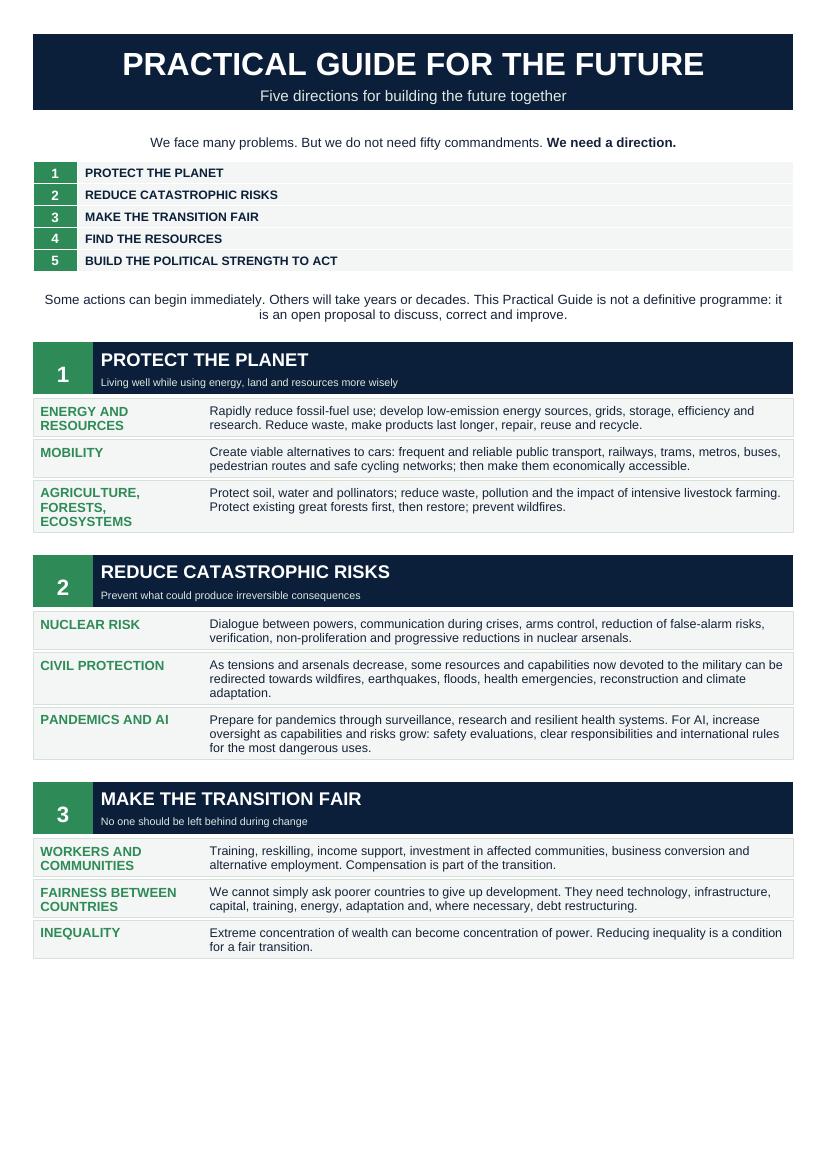 Preview of the first page
Five priorities: protect the planet, reduce catastrophic risks, make the transition fair, find the resources, and build the political strength to act.
2 pages · Designed for double-sided printing on a single sheet
DOWNLOAD THE PRACTICAL GUIDE FOR THE FUTURE
The Practical Guide
From knowledge to action
Understanding global problems is essential. But sooner or later a very concrete question arrives:
What can I do?
The No-Extinction Practical Guide proposes ten areas in which our choices can contribute to change.
It is not a list of obligations, nor a search for perfection. It is a starting point for deciding where we can act in everyday life and where, instead, we need to act together.
The ten areas
Ten areas where we can make a difference
Select an area to read the full content.
- 01
Getting informed
Understand before you choose
Recognizing which information deserves trust.
Today the problem is not only finding information. It is understanding which information deserves trust.
What you can do
Do not stop at the headline.
Before sharing a news item, read it and check where it comes from.
Look for the original source.
When studies, reports or statements are quoted, try to trace them back to the source. On scientific topics, give more weight to recognized scientific institutions and to peer-reviewed research.
Compare different sources.
An important news item independently confirmed by several reliable sources deserves greater trust.
Distinguish facts from opinions.
We can hold different opinions, but an opinion does not change a verified fact.
Test what you already believe, too.
Ask yourself: “Would I believe this just as easily if it said the opposite of what I think?”
The method, in four steps
- Stop
- Check
- Compare
- Then share
And what about AI?
Artificial intelligence can explain, summarize and compare information, but it can also get things wrong, and it can be used to create and spread disinformation. For important information, ask for the sources and check them.
- 02
Choosing carefully
Buy less. Choose better. Make it last longer.
Not all consumption carries the same weight.
Every product requires materials, energy, water and transport, and sooner or later it becomes waste. But not all consumption carries the same weight.
What you can do
Ask yourself whether you really need it.
Often the product with the lowest impact is the one we do not need to produce at all.
Make what you own last.
Repairing, maintaining, reusing and buying second-hand all reduce the need to produce new goods.
Look beyond the price.
When you can, also consider durability, repairability, origin and the environmental and social conduct of the producer.
Focus on the consumption that matters.
Cars, flights, energy, housing, food and frequent purchases weigh far more than many small symbolic gestures.
Share when it makes sense.
Lending, renting and sharing can meet the same need while using fewer resources.
Choosing well is not enough
We can choose better products. But we also need rules that make products durable and prevent the costs of production from being shifted onto the environment and society.
- 03
Eating better
What we eat has consequences too
Soil, water, energy, climate and biodiversity.
Producing food means using soil, water and energy, and it affects climate, ecosystems and biodiversity.
What you can do
Reduce the animal products with the highest impact.
Not everyone has to adopt the same diet, but a significant reduction of the most intensive and impactful forms of production can make an important difference.
Do not waste food.
Buy realistic quantities, store food properly and use leftovers.
Give more room to plant-based food.
Pulses, cereals, vegetables and fruit can play a larger role in the diet, compatibly with personal needs.
Find out how food is produced.
“Local” or “natural” do not automatically mean sustainable.
Ask for better food systems.
Farming, livestock, canteens, distribution and policies against waste can produce changes far greater than those of a single household.
Significantly improving the diet of millions of people counts for more than the perfection of a few.
- 04
Getting around
Choosing differently when we can choose
The issue is how we organize travel.
The problem is not moving around. It is how we organize travel and which alternatives we make available.
What you can do
For short trips, consider the alternatives.
Walking and cycling, where possible, remove direct energy consumption altogether.
Use public transport where it is a real alternative.
Reduce avoidable flights,
especially where reasonable rail connections exist.
If you have to use the car, use it better.
Sharing the journey and avoiding unnecessary trips can reduce its impact.
Ask for cities where choosing is possible.
Public transport, railways, safe cycle lanes and nearby services turn an individual choice into an option for millions of people.
Telling someone to give up the car when no alternative exists does not solve the problem. The alternative has to be built as well.
- 05
Home and energy
First avoid waste. Then change the system.
Structural measures make a far bigger difference.
Some everyday habits help. Structural measures can make a far bigger difference.
What you can do
Avoid obvious waste.
Do not use energy where it produces no benefit at all.
Improve the efficiency of your home when you can.
Insulation, shading and efficient systems can cut consumption for many years.
Gradually favor electrification and clean energy, where technically and economically possible.
Produce renewable energy where conditions allow.
Energy communities and shared solutions can contribute as well.
Keep an eye on orders of magnitude.
Do not focus all your attention on a forgotten phone charger while ignoring heating, insulation and other major sources of consumption.
Home and system
An efficient home also depends on us. A clean energy system requires infrastructure, investment and public decisions.
- 06
Talking about it
Persuading without preaching
How we talk matters as much as what we know.
We may understand a problem well and still push others away if we talk about it in the wrong way.
What you can do
Listen before persuading.
Try to understand why the other person thinks what they think.
Start from what you have in common.
Health, safety, peace, freedom, the future of our children and quality of life can bring together people with very different views.
Do not humiliate those who are wrong.
Winning an argument can mean losing the person we are talking to.
Do not confuse concern with catastrophism.
Hiding problems does not help; presenting them as inevitable does not help either.
Talk about the solutions too.
Fear alone can produce helplessness; showing that action is possible can turn it into participation.
Accept that you will not convince everyone.
Am I trying to make this person think, or only to prove that I am right?
- 07
Taking part
Democracy does not end with voting
Many global choices are political choices too.
Decisions about climate, energy, peace, technology and inequality are also political decisions. Taking part does not necessarily mean joining a party or becoming an activist.
What you can do
Vote with the long term in mind as well.
Consider not only immediate promises, but the consequences over the following years and decades.
Let your elected representatives know what you consider important.
One voice carries little weight; many people asking for the same thing can change priorities.
Support credible initiatives.
Check their goals, methods and reliability before joining.
Take part locally too.
Mobility, green spaces, waste, energy and climate adaptation also depend on local communities.
Think of those who will come after us.
Today's decisions will affect young people, and those not yet born, most of all.
One person has little power. Millions of people asking for the same thing can change decisions.
- 08
Acting together
Nobody changes the world alone
From individual actions to collective action.
Global problems are too big for a single person. But individual actions can organize themselves and become collective action.
What you can do
Look for other people who share the same goal.
Offer what you are good at.
Writing, teaching, organizing, designing, translating, coding, communicating: there are many ways to contribute.
Bring global problems into local communities.
Schools, municipalities and associations can become nodes of a larger change.
Connect different initiatives.
Climate, peace, biodiversity, inequality and technology are not separate worlds.
Look beyond national borders.
Many of the most important challenges cannot be governed effectively by a single state.
Nobody changes the world alone. But the world only changes when someone begins.
- 09
Peace and disarmament
Security is not just a matter of having more weapons
Prevention, diplomacy and verifiable agreements.
States have the right and the responsibility to protect their citizens. But when the pursuit of security becomes an endless arms race, it can increase mutual distrust and divert enormous resources away from other human needs.
With nuclear weapons, moreover, a conflict can take on consequences that go beyond any border.
What you can do
Get informed about defense policies as well.
Military spending, deterrence and nuclear arsenals deserve the same attention we give to other major public choices.
Support diplomacy and conflict prevention.
Avoiding a war costs immensely less — in lives and in resources — than fighting one.
Support verifiable arms control and reduction agreements.
Disarmament is more realistic when it is mutual, verifiable and built through international agreements.
Reject the dehumanisation of the enemy.
Governments and peoples are not the same thing. Treating entire populations as enemies makes it easier to accept what we would judge unacceptable in peacetime.
Ask that greater security also free up resources for life.
An agreed reduction in military spending could make enormous resources available for climate, health, education, poverty, research and cooperation.
Peace is not only the absence of war. It is a condition that has to be built before war begins.
- 10
Artificial intelligence
Using it without handing over our future
Enormous capabilities, risks to be governed.
Artificial intelligence can accelerate research, improve education, help medicine, optimise complex systems and put previously inaccessible capabilities into the hands of a great many people.
But ever more powerful tools also bring risks: manipulation, surveillance, concentration of power, autonomous weapons and, with far more capable future systems, risks whose nature and severity are still being studied and debated.
What you can do
Learn to use it instead of being subject to it.
Understanding a tool is the first step towards using it consciously.
Check what it produces.
Especially when an answer concerns important decisions.
Protect data and privacy.
Do not automatically hand personal or confidential information to tools you do not know.
Ask for transparency and accountability.
Those who develop and deploy high-impact systems must answer for their consequences.
Support common rules for the most dangerous uses.
Some applications of AI cannot be governed effectively by the decisions of individual companies or individual states alone.
Use AI to extend human capabilities, not to give up human judgement.
Artificial intelligence can help us make better decisions. It must not decide in our place what future we want.
For the wider picture: Global Problems and The Possible Solutions.
NOT EVERYTHING DEPENDS ON YOU
Individual choices matter. But they are not enough.
We can consume better, change some habits, use fewer resources, get informed, vote and take part.
But no one can individually stop global warming, prevent a nuclear war, set international rules for artificial intelligence, protect the oceans or correct the great global inequalities.
Problems of this scale also require public policies, responsible businesses, effective institutions, international agreements and cooperation between countries.
- Personal choices
- Participation
- Collective action
- Common rules
They are not alternatives. They are parts of the same answer.
The World Movement grows precisely out of the need to face together problems that no country can solve alone.
Where do you want to start?
WHERE DO YOU WANT TO START?
Do not choose twenty things. Choose one.
I GET BETTER INFORMED
I pick a problem I know little about and start from reliable sources.
I CHANGE ONE IMPORTANT CHOICE
I identify a high-impact purchase or habit that I can realistically change.
I TAKE PART
I choose an initiative or a problem to devote some of my time to.
I TALK ABOUT IT WITH SOMEONE
I share what I have discovered without trying to impose it.
I INVOLVE OTHER PEOPLE
I bring a problem, an idea or a No-Extinction tool into my school, association, group or community.
You do not have to save the world alone.
You have to decide what part you can play in changing it.
Discuss with other people in the No-Extinction Forum.
Forum currently in Italian
HELP US IMPROVE THE PRACTICAL GUIDES
These proposals are not definitive. Point out errors, suggest alternatives and help us improve them in the No-Extinction Forum.
Forum currently in Italian